Sunday, October 23, 2016

The Martian - Andy Weir

Being stranded in outer space seems like a terrifying predicament to be in, especially when you must survive out there on your own. The telling of Mark's story and how he was able to survive out on space alone is both impressive, yet jarring.

I find it incredibly interesting that one event can lead to an outcome that is completely different relative to if that even were to not take place, Mark nearly dying being the event in question. Him being abandoned not only brings out the best in him in his attempts to remain alive, but also influences the entire issue that the story revolves around. Considering possible solutions that could have used in order to prevent the issues of the story from taking place, one of them being Mark getting carried alongside his crew, it's fun to realize that that a single decision in the short-term can influence many things in the long-term.

While reading the book and considering the dilemma of the novel, I couldn't help but also relate the book to one of my favorite game franchises, Dead Space, which also involves being stranded out in space. However, aside from simply having to stay alive and try to call for help, you must also fight against an infestation that's constantly trying to kill you. Although this isn't the case in the Martian, I found that there were a lot of very similar motifs occurring between both works, aside from simply being stranded in space. The most valuable motif being Communication, which I think everyone takes for granted here on planet Earth (as opposed to being on any other planet). Without being able to call for much help, if any, both heroes are forced to resort to a somewhat contemporary yet primal instinct of utilizing their knowledge and surrounds to survive.

Friday, October 21, 2016

Anansi Boys - Neil Gaiman

Anansi boys took on a different perspective in terms of the characters we, the readers, we see the book's world through, which made the book feel much more interesting and researched. Being that nearly all of the characters are African American, it also allowed me personally to relate just a little bit more, as opposed to the main character being white, which is much more common. In particular, regardless of race, I felt I related the most to Fat Charlie which made many of his failures and successes feel much more impactful to be a part of. The most notable event in the story would be when Charlie unlocks his previously latent power in order to aid in his and his brother's escape from danger.

Aside from the characters being mostly African American, the book also took on inspiration from an African God, Anansi, which facilitated in the book's interest to many people. Many books that involve some form of diety, or the mention of one, generally pertain to Greek Gods, which made them a staple in the books of western culture. Gods like Zeus, Poseidon, Triton, etc. are the main pivot of many books that people enjoy today. Having a book inspired by an African diety was refreshing in that it provided a world for many readers were not used to seeing.

Tuesday, October 18, 2016

DISRESPECT - Print-N-Play

Click HERE to download DISRESPECT!
     In this Print-N-Play game, you can play against up to 3 other people in a race to the finish! Combo your Skill Cards to Disrespect your opponents and set them back as you push ahead and laugh maniacally on your way to the finish line!

Tuesday, October 11, 2016

My Game Idea - Sophomore Year Game Art

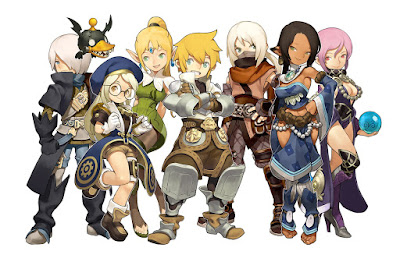
Character Art - Dragon Nest, Eyedentity Games
Topple over your opponents as you climb your way to the finish line.

Warrior - Dragon Saga, Gravity

     Theme: The game's events take place in the future, where human intelligence has increased to the point where magic and other superhuman powers are no longer latent. Tools have been created to increase the potency of these powers and these are used in the media for entertainment, similar to programs like Ninja Warrior. 
     This game, however, is simply a race between classes (Warrior, Mage, Archer, etc.) to see who can brave the elements, and each other, to reach the end of the global race track. The winner receives immense fame and glory to bring home along with a lifetime supply of hot wings.
     The game's art will be inspired by the concept art styles of Dragon Nest and Dragon Saga, giving the game a very cheery feel.

The Game's Color Palette


* Update - October 3, 2016
     A friend of mine, Nick Dahill, gave me an idea that I believed was pretty great during our Game Design Club a few days ago. Instead of having defined classes for the players, allow the players to switch off at certain points to what the classes would have been.

"Do I want to become an ice mage now so I can benefit from that area later or do I want to stay a fire mage for this area now?"

     I've incorporated this mechanic into the game which I believe has added the depth within the game I know it needed in the field of strategy. I've incorporated the several regions of the game onto a prototype board: Arctic (Ice Powers), Volcanic (Fire Powers), Mountainous (Superhuman athleticism) and the Jungle (Floral Powers). Each of these regions have their own spaces that the players will be able to use to slow their enemies down in an attempt to catch up or get ahead.
     I believe this also allows for the feeling of progression and choice, allowing players to either keep certain powers throughout the entire game or change powers at every single region, if they so choose. I want to design the board in such a way that switching off powers at every region is the best thing to do, but rather players can keep or change off powers at given points regardless of the region and still become victorious. However, there will also be a mechanic involved that prevents players from switching to a skill set that was received in a past shop. For example, if a player wishes to use the Arctic skill set, the very first skill set that the players will obtain (subject to change), they must keep it until they find that they can use something that will benefit them more. Once they switch from it, they can not go back.

* Update - October 11, 2016
      Final iteration on the names of the regions: Fire, Ice, Earth, and Forest.
   
     I've been told that having only one of four of each type of Skill Card available at only one region each made the skill cards almost completely ineffective. A suggestion, again from Nick Dahill and Alex Charnes was that I should incorporate more use of the skill cards into the game, which made sense because I want the gameplay to be contingent on these skill cards and how the players use them.
     I've practically littered the board with all the different kinds of hit zones and players can now visit the Dealer's Dock to obtain their cards from what is no the facedown pile of Skill Cards. There are still Four Regions on the board and each region has two of each element. That region's respective hit zone (i.e. Ice Region with the Ice Hit Zone) has an extra space, giving a total of 9 hit zones across each region.
     There are also benefits to casting a Skill Card in that card's region (i.e. casting the Ice Skill Card in the Ice Region, Earth Skill Card in the Earth Region, etc.). These benefits essentially make their respective skill cards stronger, allowing players to either wait to reach that region or barrage their opponents, which will hopefully make the game more fun to play.

Monday, October 3, 2016

The Night Circus - Erin Mergenstern


  Some of life's biggest issues invoke the most development in someone. In the resolution, not only do people learn more about how the world works around them, but they also learn more about how they work within the world. I've had some of my trials, one of which involves the huge step many people take in life: Going to college and tackling the career you wish to partake in. Even before this event in my life, I've learned that I do not have the ability to solve all of the problems that come my way and in these events specifically do I learn my capabilities.
     A lot of very similar issues arise within Night Circus. Celia's magic training near the beginning is what especially fixated itself to me. Witnessing her struggle in an attempt to mend a bird's wound and fail quickly reminded me of the things I've failed in the past. I believe knowing one's own capabilities is what sets them unto the "path" that they will eventually take, whether it be sooner or later. One of Celia's first training lessons involved her looking upon herself with an objective view, which I believe is important because it facilitates in making her the best she can be. I believe failing is an art that creates the best work, for if something always succeeds and has always been succeeding, it will lack the wisdom that could have been learned otherwise. Not only does failure expand the canvas with which success can be had, but it also allows one to become closer in tune with the world around them. 
     Taking into considering the fact that Celia is a wizard, although we've heard many stories like this before, I felt that there was this separation between me and her. Her failure reminded me that although we are different, there are definitely aspects of us that are the same, which is an important lesson for children who aspire to be great need to learn. As kids, the people we look up to seem almost like not-human; they seem like people that have never had to triumph over very difficult tasks. Hearing their struggles and how they rose over them is what inspires people to become greater, because that experience is what allows them to remove the guise of impossibility.

Tuesday, September 27, 2016

The Hobbit - J.R.R. Tolkien


     The Hero's adventure is one of various treacherous trials and tribulations and our Hero Bilbo creates a very great example of what a great hero's journey is like. 
     Considering what his life was like before he embarked on his journey, seeing Bilbo become what even he thought he couldn't become was incredibly gratifying. In my view, I've always seen dwarves as hardened tiny adult humans who take on various hobbies like blacksmithing and armor crafting. This took my on a journey through not only Bilbo's experiences, but through my own ideas of how much a dwarf can be.
     Bilbo seems to have somewhat "awakened," for lack of a better term, into what I previously considered to be the dwarven culture, particularly in reference to his encounter with the beloved Gollum. Not only did I feel that this encounter was terrifying, as the idea of being eaten alive does not bode well with me, or anyone else that I know for that matter, but it also showed me that dwarves are much more than meets the eye in terms of cunning. In such a short span of time, I was able to witness an experience that would change anyone for a lifetime, let alone Bilbo. Although this isn't the most treacherous part of his journey, I considered it to be a very important one. Not only because of the rapid character development, but because of how Bilbo was related to the issue at hand: He was all alone, having stumbled upon a ring, and came across a creature who saw him as a meal. Unlike having the issue of a dragon burning down the whole town, immediately effecting those around you, seeing a single character, our hero, go through a dilemma that would yield long term consequences is an interesting concept to consider. Without Bilbo, from his meeting with Gollum and onward, the other dwarves that would have needed him may not have succeeded in their quest. Seeing one small event, Bilbo accidentally stumbling upon the ring, ripple into a butterfly effect of results I feel is important within a story. It makes everything that happens onward feel like it happened for a reason, which solidifies the world that these events take place in. 

Women and Witches: Aunt Maria

     
     The subject of power in our western culture is generally one discussed based upon who has or will have the power. Aunt Maria has risen many of the questions I have about the way society generally thinks of power and how they might react to the way the Witches in this story use it.
     The older women, most of which are witches in this book, are placed in some high position of power, which is a huge contrast to what is seen in our culture. These witches are depicted as women who are very manipulative and can quickly lose their temper and misuse their power based on emotional impulse alone. I do believe that this depiction of women in power is somewhat present in our culture today, as many people see women as "over-emotional," although this is not necessarily the case.
    The book is interesting in that it places our protagonists in the world without power and gives our antagonist most of the power that creates the conflicts presented to us in the book. I enjoyed seeing Chris get the best of someone with more power than he has and witnessing her go quite a bit over the line, turning him into a wolf. This event in the book is particularly interesting because I got to witness someone with pretty much no power rise into power for a brief moment before he was rapidly dropped back down. The feeling of seeing the "little guy" become more powerful than the "bully" is a satisfying mechanism, and I believe this book pulled implemented that trope into the story pretty well.